Quick Answer:
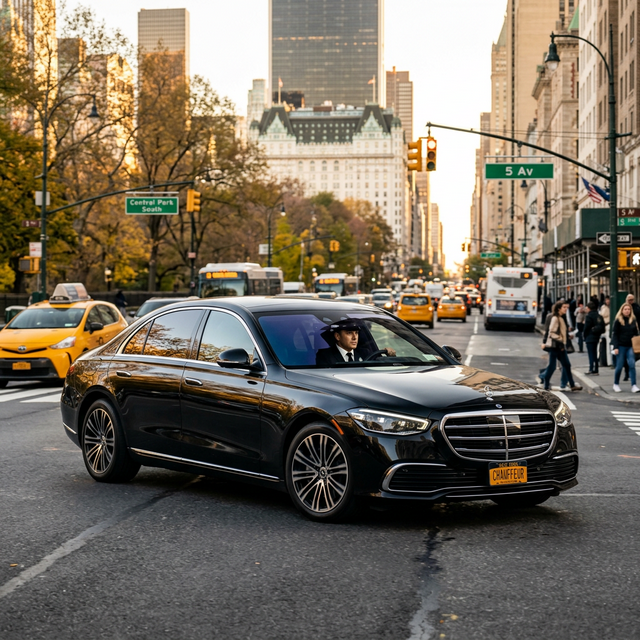
New York’s investor roadshow spans FiDi → Midtown → Hudson Yards — 45-60 min in peak traffic requiring “As Directed” (single dedicated Mercedes S-Class/V-Class for 8-10 hours). Teterboro arrival: vehicle on-site 30-40 min before landing, departing before 6:45 AM Lincoln Tunnel peak. FiDi-to-Midtown: build 45 min buffers. Hudson Yards after 3:30 PM: add 20+ min due to West 34th Street gridlock.
Why Does Manhattan’s Geography Make New York Roadshows Unique?
The global roadshow circuit has its own internal logic. London concentrates investors in a Mayfair-to-Canary Wharf axis. Zurich stays within a 3-kilometre radius. Singapore’s financial addresses are compressed into Marina Bay.
New York is different. Manhattan’s investor base is fragmented across a distinct vertical geography that creates a structural transportation challenge for every management team running a capital raise here.
The three primary New York investor clusters:
-
Lower Manhattan / Financial District (FiDi): Goldman Sachs at 200 West Street, Citadel on Hudson Boulevard E, and institutional desks at 55 Water Street anchor the lower Manhattan cluster. Tight geography but parking-hostile — specific building access during morning rush requires advance coordination.
-
Midtown East/Park Avenue Corridor: The largest concentration of asset managers, private banks, and institutional investors runs from 40th to 59th Street between Second and Sixth Avenues. BlackRock at 55 East 52nd, JPMorgan at 383 Madison, Viking Global at 600 Lexington — the density of major investor addresses in Midtown is extraordinary.
-
Hudson Yards: The new financial campus on the West Side has drawn BlackRock quantitative teams, private equity firms, and corporate hospitality venues. Practical but isolated from the Midtown core — requiring specific routing in and out.
A single roadshow day touching all three clusters involves 20-28 blocks of transit — at peak Manhattan traffic, this is 45 minutes between clusters. This is not a 15-minute cab ride. It is a planned, managed movement that determines whether the day runs or collapses.
How Does Manhattan’s Traffic Architecture Shape Roadshow Timing?
Manhattan’s traffic is not random — it follows a predictable daily cycle that informed roadshow scheduling must account for:
Morning peak (6:45 AM – 9:30 AM): Lincoln Tunnel and Holland Tunnel inbound dominate. FDR Drive northbound congestion peaks at 8:15-8:45 AM. FiDi parking structures fill by 7:30 AM. A roadshow team targeting 8:00 AM FiDi meetings must be positioned by 7:15 AM at the latest.
Midday window (10:00 AM – 12:00 PM): The operational sweet spot. Tunnel clearance is manageable, FDR Drive flows freely, parking structures have turnover space. This is the most reliable 2-hour window in Manhattan traffic.
Lunch congestion (12:00 PM – 2:00 PM): Counterintuitively, this window is often more predictable than the morning rush. Surface street routing (Park Avenue, Madison Avenue) frequently outperforms highway alternatives during this period.
Afternoon peak (3:00 PM – 7:30 PM): The Lincoln Tunnel outbound queue begins building by 3:00 PM and reaches gridlock by 4:30 PM. West 34th Street westbound becomes impassable. Teams with Teterboro departures must clear Midtown by 2:30 PM at the latest to avoid the tunnel queue.
What Specific Address Density Matters for New York Roadshows?
The practical density of New York’s investor base means roadshow routes are often decided by proximity, not priority. The most common clustering error is treating Midtown as a single location when it spans 20 blocks and three distinct sub-corridors:
- Park Avenue corridor (East 40th–59th): The institutional heart — BlackRock, Vanguard, JPMorgan, and Elliott all operate on or adjacent to Park Avenue. A meeting at 55 East 52nd and a meeting at 600 Lexington are separated by 2.5 kilometres and 15 minutes of transit.
- Times Square / West 50th corridor: Private equity and emerging market funds concentrated west of 6th Avenue. Often the third or fourth meeting of a day, when fatigue is a factor.
- Rockefeller Center district: GE Plaza at 30 Rockefeller Center marks the northern edge of Midtown’s practical roadshow range. Beyond 59th Street, transit times to FiDi become prohibitive for a same-day itinerary.
Why Is “As Directed” the Non-Negotiable Structure for New York Roadshows?
The “As Directed” service is the professional term for what most roadshow coordinators understand as a “dedicated vehicle for the day.” It means: the vehicle is yours, the driver is briefed on your full schedule, and neither vehicle nor driver goes elsewhere during your assignment.
This is structurally different from “on-demand” bookings. In a New York roadshow context, on-demand bookings create four specific failure modes:
| Failure Mode | Impact | As Directed Solution |
|---|---|---|
| Availability failure | At 8:45 AM Midtown, every executive vehicle is committed — on-demand fills with what remains | Dedicated vehicle pre-booked and positioned |
| Knowledge discontinuity | New driver between each meeting lacks schedule context — team explains their situation every leg | Same driver throughout — knows the day’s rhythm |
| Reactive routing | Navigation app doesn’t account for 7-minute delays from double-parked trucks | Local knowledge pre-flags issues before meetings end |
| No buffer management | Overrunning 2:00 PM meeting leaves team stranded | Operations desk communicates delays outward and reroutes |
For any roadshow spanning three or more meetings, “As Directed” is not a premium option. It is the baseline operational requirement.
What Distinguishes a Roadshow-Grade Driver from a Standard Chauffeur in New York?
Not all New York chauffeurs are equipped for roadshow operations. The difference between a roadshow-grade driver and a standard executive driver in New York is operational intelligence:
A standard driver knows how to get from A to B. A roadshow-graded BYZAS driver additionally knows:
- That the Goldman Sachs main entrance at 200 West Street has specific vehicle access protocols during morning hours
- That the Citadel garage entrance on Hudson Boulevard E is frequently congested between 8:00-9:00 AM and requires advance positioning
- That Viking Global at 600 Lexington has a dedicated passenger drop-off on Lexington Avenue that avoids the garage queue
- That BlackRock at 55 East 52nd requires advance visitor registration that must be coordinated by the IR team before the day
This is not navigational knowledge. It is institutional knowledge that comes from running New York roadshow circuits repeatedly and learning which building access sequences create delays.
How Do You Handle a Teterboro Pre-Dawn Arrival?
For management teams arriving from the West Coast, Europe, or Asia on private aviation, Teterboro Airport (TEB) in New Jersey is the primary Northeast gateway. Teterboro handles the highest volume of private aircraft movements of any field in the region — approximately 14 kilometres from Midtown Manhattan via the Lincoln Tunnel.
A Teterboro pre-dawn arrival (5:30-6:30 AM for 8:00 AM Wall Street meetings) is a specific logistical sequence that experienced New York executive chauffeur operators handle differently from standard airport pickups.
The three critical Teterboro variables:
-
Traffic window: Lincoln Tunnel at 5:45 AM is passable in 15-20 minutes. By 7:15 AM, it is 40+ minutes. A team landing at 5:30 AM and departing Teterboro by 5:50 AM reaches Wall Street before the FiDi morning peak. The same team delaying departure to 7:00 AM arrives in the middle of it.
-
Apron access coordination: The vehicle must have confirmed apron access (coordinated with the specific FBO — Signature, Jet Aviation, or Meridian — before the aircraft arrives). A vehicle waiting outside FBO gates while the principal stands with luggage on the apron is a failure.
-
Vehicle pre-configuration: The driver arriving at Teterboro is the same driver running the entire day. The vehicle must already be configured for a full working day: charged devices, connectivity active, refreshments per brief, boot clear for materials.
Why Does Teterboro Require Different FBO Protocol Than JFK or Newark?
Teterboro operates under different access protocols than the major commercial airports. FBO access at Teterboro is not automatic — it requires pre-coordination with the specific FBO operator, and the coordination must happen the business day before arrival, not on the morning of.
The three main Teterboro FBOs have distinct access characteristics:
- Signature Flight Support (TEB): The highest-volume FBO at Teterboro. Vehicle access requires advance clearance and specific gate positioning. BYZAS maintains a standing relationship with Signature TEB operations.
- Jet Aviation (TEB): Preferred for mid-size cabin aircraft. More contained than Signature, with dedicated client vehicle staging areas accessible without full apron access.
- Meridian Teterboro (TEB): The premium FBO for ultra-long-range and heavy jet operations. Meridian’s client service level is the highest of the three, and their vehicle staging protocol is the most structured.
For a pre-dawn arrival, the vehicle positioning sequence is:
- Driver receives aircraft ETA and tail number from IR coordinator the night before
- Driver contacts FBO operations to confirm apron access window (typically 30-45 minutes before landing)
- Driver arrives at FBO 35 minutes before landing, parks in designated client vehicle area
- Driver receives principal at aircraft door, manages luggage directly
- Vehicle departs Teterboro within 5 minutes of principal boarding
What Is the FiDi-to-Midtown Transit Challenge?
The gap between a 1:00 PM Wall Street meeting finishing and a 2:30 PM Midtown meeting is either comfortable or catastrophic — depending entirely on current traffic on the FDR Drive or Broadway.
Routing options from FiDi to Midtown:
-
FDR Drive (East Side): Fastest under normal conditions — direct northbound highway from downtown waterfront to 59th Street Bridge interchange. Downside: completely stochastic during peak hours.
-
West Side Highway / Route 9A: Faster in morning peak but congested at lunchtime. The Hudson Yards outlet at West 34th Street is efficient if Midtown meetings are on the West Side.
-
Broadway or 6th Avenue: Slow but predictable — surface streets move at a consistent pace even in peak traffic. The advantage is granular control over arrival timing: the driver knows they’re 8 minutes out, not 3 minutes out due to a variable that cleared.
A driver who has run New York roadshow circuits makes this routing decision in real time — not from a navigation app. Navigation apps do not account for the seven minutes lost to a delivery truck double-parked at 55th and Park. Local knowledge does.
How Do You Handle Midtown Parking and Building Access Protocols?
Every Midtown office building has its own vehicle access protocol — and the roadshow team needs to know each one. The three categories of Midtown building access:
Category 1 — Street-level drop-off (no garage): Goldman Sachs at 383 Madison, JPMorgan at 383 Madison, and Citadel at 601 Lexington all have street-level passenger drop-off. The driver’s job is to position correctly on the correct side of the street (with or against traffic flow) and manage the brief loading/unloading window without triggering parking violations. A two-minute unauthorized stop in Midtown generates a ticket. A professionally managed drop-off is invisible to the street.
Category 2 — Managed garage access: Most Midtown buildings require visitors to use specific garage levels, often accessed from side streets. Some require advance registration of license plates. The IR coordinator must provide this information to the transportation team before the day, not at the meeting.
Category 3 — Institutional credentialing: Some buildings (particularly those housing hedge fund principals) require advance visitor registration with photo ID. This cannot be arranged on the day. BYZAS coordinates building access protocols as part of the pre-briefing process — the IR team provides the meeting participant list, and we handle building access confirmation.
What Makes Hudson Yards a New Factor in New York Roadshows?
Hudson Yards (30/50/55 Hudson Yards) has introduced a new transit challenge into the New York roadshow circuit. The campus is accessible via the 7 Train for pedestrians, but for a roadshow team with materials, a dedicated vehicle is the only practical option.
From Midtown (Park Avenue corridor), routing via 9th Avenue and West 33rd Street takes 15-25 minutes in normal conditions. During the late afternoon, however, the West 34th Street corridor becomes gridlocked as commuters merge with the Lincoln Tunnel inbound queue — adding 20+ minutes to what looks like a 20-minute journey.
Teams scheduling a Hudson Yards meeting after 3:30 PM should confirm departure time accounts for this gridlock, particularly if the day ends with a Teterboro departure.
What Is the Optimal Hudson Yards Meeting Timing?
For a full-day New York roadshow ending with a Teterboro departure, Hudson Yards meetings should be scheduled no later than 2:30 PM. This allows a 15-minute buffer for the meeting conclusion, a 25-minute transit to the Holland Tunnel approach, and a 20-minute clearance through the tunnel to Teterboro by 4:00 PM — well before the evening queue develops.
For teams running a midday Hudson Yards meeting in isolation (not as part of a full-day roadshow), the window between 10:00 AM and 1:00 PM offers the most reliable transit performance.
What Vehicle Configuration Does a New York Roadshow Require?
Between meetings, the vehicle is a working environment. The 40 minutes between a 10:30 AM FiDi meeting and an 11:45 AM Midtown meeting is not downtime — it is uninterrupted preparation time for the CFO to refine messaging.
Vehicle requirements for roadshow-level service:
- Acoustic isolation: The Mercedes S-Class provides the closest approximation to a private office available in moving traffic — categorically different from an SUV or standard executive saloon
- Connectivity: 4G/5G reliability in Manhattan is variable — tunnels, building canyons, and tower congestion at financial districts affect signal. A properly equipped vehicle carries a connectivity booster and portable hotspot backup
- Charging: Management teams in active roadshows burn through device batteries. Every seat position must have charge access
- Materials management: Investor binders, presentation tablets, and executive documents need to be accessible quickly — vehicle interior organisation should accommodate this without negotiation
These are not luxury features. They are the functional requirements of a New York roadshow chauffeur service at the level the market expects.
How Do You Manage Schedule Disruptions During a New York Roadshow?
Meeting overruns are a structural certainty in New York roadshows — not a possibility. The question is whether you have a system to absorb them or whether they cascade through your entire day.
The operations model that prevents schedule collapse:
- Pre-briefed “As Directed” driver — knows the full day’s schedule, monitors timing from the moment each meeting starts
- Real-time IR coordinator communication — the driver’s contact is the IR coordinator, not the management team directly
- Venue-alert protocol — when a meeting overruns by 15+ minutes, the next venue is notified before the management team even exits the current meeting
- Routing buffer — the driver builds 5-10 minutes of buffer into every transition where schedule permits, absorbing minor overruns without action required
The difference between reactive and proactive roadshow management:
- Reactive: Team finishes overrunning meeting, scrambles to find driver, rushes to next venue 10 minutes late
- Proactive: Driver notifies operations during the overrunning meeting, next venue adjusts their timeline, team exits to vehicle that is already repositioned and ready
A professional New York roadshow operation should never require the management team to think about transportation logistics. If they are, the operation has already failed.
What Common Mistakes Do New York Roadshow Teams Make with Ground Transport?
Mistake #1: Booking based on daily rate rather than operational capability. The cheapest available New York executive vehicle on the day of a major roadshow is available for a reason — it’s the vehicle no one else booked because it’s the last vehicle in the fleet that arrived late, had documentation issues, or belongs to an operator with no New York roadshow circuit experience.
Mistake #2: Treating the vehicle as transport rather than logistics infrastructure. The vehicle should function as a rolling operations centre: driver ↔ operations desk ↔ IR coordinator ↔ next venue, with the management team isolated from the coordination entirely.
Mistake #3: No Teterboro FBO pre-coordination. Landing at Teterboro at 6:00 AM and expecting the vehicle to be at the aircraft door without prior FBO coordination is how operational failures begin. FBO access at Teterboro is coordinated the business day before, not the morning of.
Mistake #4: Midtown building access not confirmed. Walking into 55 East 52nd without advance visitor registration creates a 10-15 minute delay at the lobby. This delay is then compounded by the subsequent schedule shift. Building access must be confirmed before the day starts.
Why Is Precision the Product in New York Investor Roadshows?
New York investor roadshows are executed in a market where management teams are held to a high standard of professionalism by the investors receiving them. The quality of the pitch matters. The quality of the materials matters. The punctuality matters.
The ground logistics either support this standard or undermine it. There is no neutral position.
- A management team that arrives four minutes late to a Goldman Sachs desk meeting because of a routing error is telling that desk something about their operational rigour
- A team that arrives two minutes early, calm and prepared, is telling them something different
Build the transportation as carefully as you build the presentation. The investors will notice.
Contact BYZAS for New York roadshow logistics planning →
Written by the BYZAS Team. BYZAS is a luxury chauffeur service with over 50 years of operational experience in Turkey, specialising in production logistics, executive transport, and high-security ground operations. Last updated: April 2026.
External Resources:
- NYC Department of Transportation - Manhattan Traffic Info
- Port Authority of New York and New Jersey - Traffic Updates
- Bloomberg - Financial District Coverage
- Wall Street Journal - Markets and Finance
- Farnborough Airport - Private Aviation Services